

Pure Raw Honey
How to Choose Pure Raw Honey: A Complete Guide to Himalayan Multi-Floral Honey
Walk into any supermarket or search for honey online and you will find dozens of choices.
Natural honey. Raw honey. Pure honey. Organic honey. Forest honey. Multi-floral honey. Himalayan honey.
With so many descriptions, choosing the right jar can become surprisingly confusing.
Does crystallised honey mean it is pure?
Is darker honey better?
What does “raw” actually mean?
Can you identify adulterated honey at home?
Does “Himalayan” automatically mean the honey is better?
The truth is that honey quality cannot be determined by one simple visual test or one marketing word.
A better approach is to understand where the honey comes from, how it is collected, how it is handled and how its quality can be scientifically evaluated.
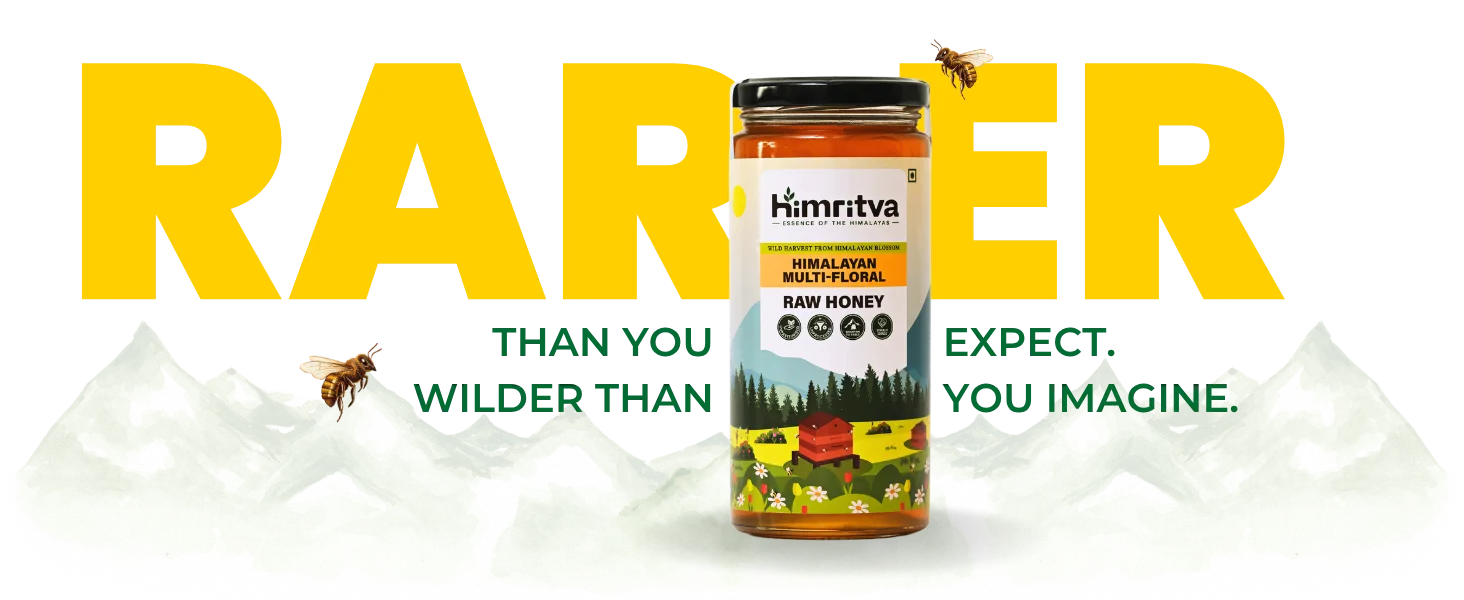
At Himritva, our Himalayan Multi-Floral Raw Honey is sourced through Pahadi beekeepers and Himalayan communities. The bees forage across diverse floral landscapes, while our HimRatnas care for the colonies and form an important part of the journey from hive to home.
In this guide, we’ll explore how to choose good-quality raw honey and what the important quality markers actually mean.
What Is Pure Honey?
Honey is a natural sweet substance produced by honeybees from flower nectar or plant secretions. Bees collect, transform and store the material in honeycomb where it ripens.
FSSAI’s definition similarly describes honey as a natural sweet substance produced by honeybees from blossom nectar or plant secretions that bees collect, transform and store in honeycombs for ripening.
That definition gives us an important starting point.
Real honey begins with bees.
Its natural composition includes sugars, water and smaller quantities of other substances that can vary depending on floral and geographical origin.
Therefore, honey is not simply a bottle of sugar syrup.
It is a naturally produced bee product with a complex composition.
What Does “Raw Honey” Mean?
The term raw honey is widely used by honey brands, but consumers should understand the processing behind the claim.
In general, raw honey is used to describe honey that has undergone relatively limited processing and has not been subjected to unnecessary high-temperature treatment.
At Himritva, we describe our honey as Raw Himalayan Honey because it is naturally collected and carefully handled without unnecessary thermal processing.
However, “raw” should not be interpreted to mean that the honey has never experienced any temperature change whatsoever.
Honey naturally exists in different environmental conditions, and normal harvesting, handling and storage can involve temperature variation.
The more useful question is:
How is the honey handled between the hive and the jar?
The Codex standard for honey states that honey should not be heated or processed to an extent that changes its essential composition or impairs its quality.
That is a much more meaningful way to think about raw honey.
What Is Multi-Floral Honey?
Multi-floral honey is honey derived from nectar collected by bees from multiple floral sources.
Instead of relying primarily on one identified flowering plant, bees may forage across a variety of flowers available around their hives.
In the Himalayas, this can mean different flowering plants and wild flora contributing to the honey depending on:
- Location
- Altitude
- Season
- Weather
- Flowering cycles
- Bee foraging patterns
This is why Himalayan multi-floral honey doesn’t necessarily look or taste identical throughout the year.
One harvest may be lighter and delicate.
Another may be deeper in colour with a stronger floral aroma.
Natural variation is expected.
Does Himalayan Honey Come From One Flower?
Not necessarily.
The term Himalayan honey primarily describes geographical sourcing.
A Himalayan honey product can be multi-floral or associated with a specific floral source, depending on how it is sourced and labelled.
Himritva’s product is Himalayan Multi-Floral Raw Honey, meaning the honey is associated with multiple floral sources rather than being marketed as a single-flower varietal.
This distinction matters.
A brand shouldn’t imply that every honey harvested in the Himalayas has exactly the same floral profile.
Nature doesn’t work that way.
What Makes Himalayan Multi-Floral Honey Unique?
The Himalayan landscape provides a diverse environment for beekeeping.
Seasonal flowering, wild vegetation, agricultural landscapes and changing elevations can create different foraging opportunities for bees.
As bees move between available flowers, the nectar entering a hive can reflect that surrounding floral environment.
This can influence the final honey’s:
Colour
Aroma
Flavour
Texture
Crystallisation pattern
Composition
The result is a honey that can carry characteristics of its surroundings without needing artificial flavouring or colouring.
For Himritva, this natural connection is central to the product story.
How to Identify Good-Quality Raw Honey
There is no single home trick that can prove honey purity.
Instead, look at the entire product.
Here are some of the most useful things to consider.
1. Check the Ingredient List
Pure honey should have a straightforward ingredient declaration.
If you are buying a product marketed as honey, check whether other sweeteners, syrups or flavouring ingredients are listed.
A simple ingredient list is an important first step.
But remember:
An ingredient label alone cannot prove authenticity.
Laboratory analysis is more powerful for detecting certain forms of adulteration.
2. Understand the Source
Ask where the honey comes from.
Does the brand identify:
- The region?
- The beekeepers?
- The floral type?
- The harvesting community?
- The sourcing process?
“From the Himalayas” is more meaningful when the brand can explain the actual sourcing story.
At Himritva, we work through Pahadi beekeepers and Himalayan communities, which helps connect the product with the people behind its journey.
3. Look for Relevant Testing
Modern honey testing can evaluate much more than colour or thickness.
FSSAI’s current honey testing manual includes methods for analysing parameters such as:
- Moisture
- Reducing sugars
- Sucrose
- Fructose-glucose ratio
- Acidity
- HMF
- Diastase activity
- C4 sugars
- Pollen and plant elements
- Proline
- Electrical conductivity
- Foreign oligosaccharides
- Specific syrup markers
These tests provide a much more meaningful picture of honey quality and authenticity.
If a brand makes strong purity claims, laboratory testing is valuable supporting evidence.
Why Honey Moisture Matters
Moisture is an important quality parameter in honey.
FSSAI’s current standard lists a maximum moisture content of 20% by mass for the general honey category covered by the standard.
Why does it matter?
Honey with excessive moisture can be more susceptible to fermentation and quality deterioration.
Bees naturally reduce the water content of nectar as honey matures in the hive.
That is one of the remarkable parts of the honey-making process.
The nectar collected from flowers is not simply bottled as-is.
The bees transform and concentrate it.
This is another reason mature honey harvesting and proper storage matter.
What Is HMF in Honey?
If you have ever read a professional honey laboratory report, you may have come across the term HMF.
HMF stands for 5-hydroxymethylfurfural.
It is a compound that can form through the breakdown of sugars and can increase with excessive heating and prolonged storage.
For this reason, HMF is an important parameter used when evaluating honey quality and processing.
FSSAI’s current standard specifies a maximum HMF level of 80 mg/kg for the honey category listed in its standard.
The exact HMF result should therefore be interpreted in relation to the applicable standard and the product’s circumstances.
This is also why a responsible honey brand should avoid simplistic claims such as:
“Low HMF = automatically pure honey.”
Honey quality is multi-dimensional.
HMF is one parameter—not the entire story.
What Is Diastase Activity?
Diastase is a naturally occurring enzyme associated with honey.
Its activity can decrease over time and can be affected by heat.
FSSAI’s 2024 honey analysis manual describes diastase as an enzyme naturally found in honey and notes that it degrades over time, especially with exposure to heat.
FSSAI’s cited standard specifies a minimum diastase activity of 3 Schade units per gram for the relevant honey category.
This makes diastase activity another useful analytical parameter when evaluating honey.
But again, it should be considered alongside other tests.
Why Are C4 Sugars Tested in Honey?
One major concern in the honey industry is the addition of inexpensive sugar sources.
Honey naturally contains sugars, primarily fructose and glucose, so simply testing for “sugar” isn’t enough to determine authenticity.
This is where more specialized analytical approaches become useful.
FSSAI includes C4 sugar analysis among its honey quality parameters and specifies a maximum of 7% under the cited standard.
Its laboratory manual also includes analytical approaches for detecting C4 sugars and other markers relevant to honey authenticity.
This is one reason laboratory testing is far more reliable than viral social-media tests.
Can You Test Honey Purity at Home?
You have probably seen the popular internet tests:
Water Test
Flame Test
Thumb Test
Bread Test
Ant Test
These tests are often presented as simple ways to identify pure honey.
Unfortunately, they should not be treated as scientific proof of authenticity.
Honey naturally has different viscosity, moisture and sugar composition depending on its source.
For example, a honey’s behaviour in water can vary for reasons unrelated to adulteration.
Similarly, burning behaviour isn’t a reliable standalone method for proving purity.
The bottom line:
Home tests can be interesting, but laboratory analysis is the appropriate tool for meaningful authenticity testing.
Does Crystallised Honey Mean It Is Pure?
No.
But it also doesn’t mean that something is wrong.
Honey naturally crystallises because it contains sugars in a supersaturated solution.
Different honey varieties crystallise at different rates.
Some may remain liquid for long periods.
Others may crystallise relatively quickly.
Floral source, glucose-to-fructose balance, temperature and storage conditions can all influence crystallisation.
So:
Crystallised honey is not automatically pure.
And:
Liquid honey is not automatically adulterated.
Texture is simply one characteristic of honey.
It should never be used as the only purity test.
Why Does Honey Change Colour?
Natural honey can range from very light shades to deeper amber and brown tones.
FSSAI’s honey regulation notes that honey colour can vary from light to dark brown.
The colour can be influenced by floral source and other factors.
Multi-floral honey may show particularly noticeable variation because different flowers contribute to different harvests.
This is why you shouldn’t automatically assume:
Darker = better
or
Lighter = purer
Neither statement is scientifically reliable on its own.
Should Raw Honey Have a Strong Floral Aroma?
It can, but there is no single “correct” aroma.
Multi-floral honey can have:
- Delicate floral notes
- Herbal notes
- Warm sweetness
- Woody notes
- Fruity notes
- More pronounced aromas
The profile depends on its floral sources and harvest.
This natural diversity is one of the reasons multi-floral honey is interesting.
You’re not necessarily buying a standardized flavour.
You’re buying a product influenced by its natural environment.
Raw Honey and Artificial Sweeteners
A common concern among consumers is whether honey contains added sugar syrup or artificial sweeteners.
For Himritva, our positioning is straightforward:
No intentionally added sugar syrup or artificial sweeteners.
The honey’s natural sweetness comes from nectar collected and transformed by bees.
This is also why the ingredient declaration and appropriate laboratory testing matter when evaluating honey products.
A brand should not rely only on the words “100% pure” printed on the front of a jar.
Raw Honey and Artificial Flavouring
Good honey doesn’t need an artificial floral flavour.
The aroma of honey naturally comes from its chemical composition and floral origin.
Himritva Himalayan Multi-Floral Raw Honey contains no intentionally added artificial flavours or synthetic aromas.
Its distinctive taste and fragrance come naturally from the floral nectar collected by bees.
This is particularly important for multi-floral honey because its sensory profile can naturally change with the floral environment.
Why Pahadi Beekeepers Matter
Honey isn’t manufactured in a factory.
It begins with bees.
But bees need people to care for their colonies.
Pahadi beekeepers understand local conditions, seasonal flowering and the practical realities of maintaining bee colonies.
At Himritva, these beekeepers are part of our HimRatna community.
Our approach is to work directly with Pahadi farmers and Himalayan communities, creating better market opportunities for the people behind every jar.
This means our honey story has three important layers:
NATURE
The flowers and Himalayan landscape.
BEES
The natural process that transforms nectar into honey.
PEOPLE
The Pahadi beekeepers who care for the colonies and harvest the honey.
Remove any one of those elements and the story isn’t complete.
From Himalayan Flowers to Your Home
The journey of Himritva Raw Honey can be understood in five stages.
HIMALAYAN FLOWERS
Seasonal flowers and mountain flora provide nectar for foraging bees.
BEE FORAGING
Bees collect nectar and return to their colonies.
HONEYCOMB
The nectar is naturally transformed and stored in honeycomb as honey matures.
PAHADI BEEKEEPERS
Our HimRatnas care for the colonies and carefully harvest mature honey.
YOUR HOME
The honey is handled and packed before making its way from Himalayan communities to your kitchen.
From Himalayan Flowers. Through Pahadi Beekeepers. To Your Home.
How to Enjoy Himalayan Multi-Floral Raw Honey
Raw honey isn’t limited to your morning tea.
Its floral character makes it incredibly versatile.
With Breakfast
Drizzle it over oats, toast, pancakes, fruits or breakfast bowls.
With Yogurt
Combine it with plain yogurt, nuts and seeds.
In Smoothies
Use it as a natural sweetening ingredient in your preferred smoothie.
With Nuts
Honey pairs naturally with almonds, walnuts and other nuts.
In Desserts
Use it in selected homemade desserts where its flavour complements the recipe.
Straight From the Jar
A small spoonful lets you experience the natural aroma and flavour directly.
One note: if you’re specifically trying to preserve heat-sensitive characteristics associated with raw honey, avoid assuming that adding it to very hot food or beverages is equivalent to consuming it without heating.
How to Store Raw Honey
Proper storage is simple.
Keep your honey:
Tightly sealed
Away from direct sunlight
Away from excess moisture
At a stable room temperature
Always use a clean, dry spoon when serving.
If your honey crystallises, that doesn’t automatically mean it has spoiled.
Natural crystallisation is a common characteristic of honey.
The important thing is to protect the product from contamination and excessive moisture.
Who Should Not Consume Honey?
There is one particularly important safety point.
Honey should not be given to infants under 12 months of age because of the risk of infant botulism.
For older children and adults, honey can be consumed according to individual dietary needs.
And while honey is a natural food, it is still a significant source of sugars.
It should therefore be enjoyed as part of a balanced diet rather than treated as a limitless health food.
Is Himalayan Raw Honey Healthier Than Regular Honey?
This is a question we hear often.
The honest answer is: you should be careful with that comparison.
Geographical origin doesn’t automatically make one honey universally healthier than another.
Similarly, the word “raw” should not be used as a blanket medical claim.
Honey’s composition varies according to floral source and geography, and it contains naturally occurring sugars along with smaller quantities of other compounds.
For Himritva, the strongest reasons to choose Himalayan Multi-Floral Raw Honey are its:
Natural floral character
Himalayan sourcing
Pahadi beekeeper connection
Minimal unnecessary processing
Transparent sourcing story
Distinctive taste and aroma
These are meaningful product qualities without making unsupported medical promises.
Why Choose Himritva Himalayan Multi-Floral Raw Honey?
There are many honey brands available today.
Our difference starts with the sourcing philosophy.
HIMALAYAN SOURCING
Our honey is connected to Himalayan landscapes and beekeeping communities.
MULTI-FLORAL CHARACTER
Bees forage across diverse seasonal floral sources rather than relying on a single floral identity.
RAW & CAREFULLY HANDLED
The honey is naturally collected and handled without unnecessary thermal processing.
NO INTENTIONALLY ADDED SWEETENERS
No sugar syrup or artificial sweeteners are intentionally added.
NO ARTIFICIAL FLAVOURING
No artificial flavours or synthetic aromas are intentionally added.
PAHADI BEEKEEPERS
We work through HimRatna communities and Himalayan beekeepers who are part of the sourcing journey.
For us, these aren’t just marketing points.
They’re the foundation of the product story.
What Should You Look for Before Buying Honey?
Before purchasing your next jar, ask yourself these questions:
Where was the honey sourced?
Who are the beekeepers?
Is it single-floral or multi-floral?
How is it processed?
Does the brand explain what “raw” means?
Are there laboratory tests?
Does the ingredient declaration make sense?
Are purity claims supported by evidence?
Can the brand explain its supply chain?
These questions are far more useful than judging a honey solely by colour, thickness or crystallisation.
The Real Meaning of “From the Himalayas”
For us, Himalayan honey isn’t simply about putting a mountain image on a label.
It’s about the journey.
It starts with flowering landscapes.
It continues with bees moving between flowers.
It involves beekeepers who care for their colonies.
It reaches the honeycomb.
And finally, it reaches your kitchen.
That’s why Himritva talks about Himalayas to Home.
Because the distance between a mountain beekeeper and a consumer should not have to erase the story in between.
Frequently Asked Questions
There is no reliable single home test for honey purity. Look at the ingredient declaration, sourcing information and, most importantly, relevant laboratory testing. FSSAI’s honey-testing methods include multiple authenticity and quality parameters.
Crystallisation is a natural characteristic of honey, but it does not prove purity by itself. Different floral sources crystallise at different rates.
Raw honey is generally associated with minimal processing and limited thermal treatment. However, “raw” alone does not prove superior quality; sourcing, handling, testing and storage also matter.
Multi-floral honey comes from nectar collected by bees from multiple flowering plants. Its flavour, aroma and colour can naturally vary depending on season and location.
Himritva does not intentionally add sugar syrup or artificial sweeteners to its Raw Honey. The product’s sweetness comes naturally from nectar collected and transformed by bees.
Honey can naturally range from light to dark shades depending on floral source and other factors. FSSAI recognises natural variation in honey colour.
HMF, or hydroxymethylfurfural, is a compound that can form during sugar degradation and is used as a honey-quality parameter. FSSAI specifies a maximum HMF level of 80 mg/kg for the applicable honey category in its standard.
Keep it tightly sealed in a clean, dry place away from direct sunlight and excess moisture. Use a clean, dry spoon and follow the storage instructions on the product packaging.