

Uncategorized
Himalayan Multi-Floral Raw Honey: From Himalayan Flowers to Your Home
Honey is one of the oldest foods known to humankind.
Yet every jar of honey has a surprisingly complex story behind it. It begins with flowers, nectar and bees, continues inside the hive, and eventually reaches our kitchens as the golden food we know as honey.
But not all honey tastes, looks or behaves exactly the same.
Floral sources, geography, season, climate, bee species and harvesting practices can influence honey’s colour, aroma, flavour, viscosity and composition. Scientific reviews also note that the composition of honey can vary considerably according to floral and geographical origin.
This becomes particularly interesting when we talk about Himalayan Multi-Floral Raw Honey.
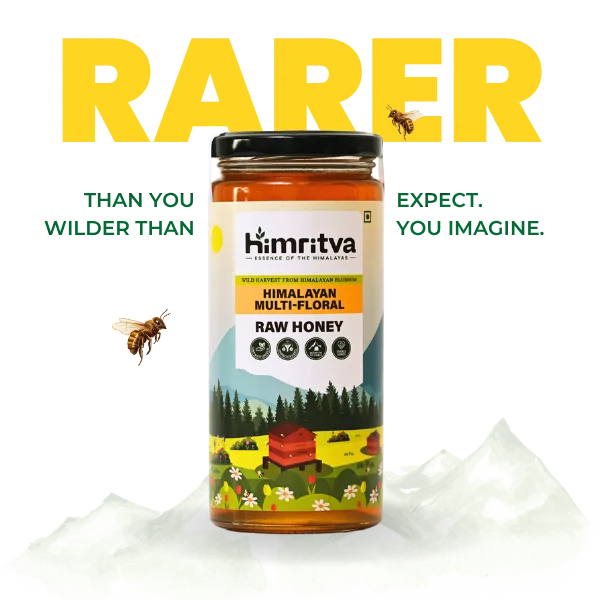
At Himritva, our honey is sourced through Pahadi beekeepers and Himalayan communities, connecting the honey in every jar with the mountain landscapes where bees forage and the people who care for the hives.
So, what exactly is Himalayan raw honey? What does “multi-floral” mean? Is raw honey really unprocessed? Why does honey crystallise? And how can you understand honey quality?
Let’s explore the journey from Himalayan flowers to your home.
What Is Himalayan Raw Honey?
Himalayan Raw Honey is honey sourced through beekeeping communities in the Himalayan region and naturally collected from honeybee colonies.
The word “Himalayan” primarily tells you about the geographical origin and sourcing story. It does not mean that every jar has an identical composition.
The Himalayan landscape contains a wide range of flowering plants, agricultural crops, wild flora and seasonal vegetation. Bees may forage across different available floral sources depending on location, season and weather.
This is one reason honey from different Himalayan locations or harvests can naturally differ in:
- Colour
- Aroma
- Flavour
- Texture
- Viscosity
- Crystallisation behaviour
Scientific literature similarly identifies floral source, geographical and environmental conditions, bee type and extraction method as factors that can influence honey’s composition and sensory characteristics.
For Himritva, the goal is to bring this natural character of Himalayan honey to consumers while maintaining a close connection with Pahadi beekeepers.
What Does Multi-Floral Honey Mean?
The phrase multi-floral honey refers to honey produced from nectar gathered by bees from multiple floral sources rather than being associated primarily with one identified floral source.
Imagine a Himalayan landscape during flowering season.
There may be wildflowers, flowering plants, trees, shrubs and agricultural vegetation growing within the bees’ foraging range.
Honeybees visit flowers to collect nectar and pollen. When multiple floral sources contribute to the honey harvest, the resulting honey can have a more diverse floral character.
This doesn’t mean that every flower contributes equally.
The exact combination depends on:
Location + season + weather + flowering plants + bee foraging patterns.
That is why two batches of Himalayan multi-floral honey can naturally look or taste slightly different.
And that’s not necessarily a problem.
It is part of the character of a naturally sourced agricultural product.
How Do Bees Turn Flower Nectar Into Honey?
Honey production begins with the bees.
When honeybees visit flowers, they collect nectar and transport it back to the hive.
Inside the colony, nectar undergoes natural transformation through enzymatic activity and evaporation. Bees deposit and manipulate the nectar within honeycomb cells, while water content decreases as the honey matures.
Eventually, the bees store the honey in the comb.
This is an extraordinary natural process.
01 — BEES FORAGE
Bees travel across their surrounding landscape, visiting flowers and collecting nectar.
02 — NECTAR RETURNS TO THE HIVE
The collected nectar is carried back to the colony.
03 — NATURAL TRANSFORMATION
Bees process the nectar through natural enzymatic activity and help reduce its water content.
04 — HONEY MATURES IN THE COMB
The honey is stored inside honeycomb cells as it matures.
05 — HONEY IS HARVESTED
Beekeepers carefully collect mature honey from the honeycomb and prepare it for consumption.
At Himritva, this journey connects Himalayan flowers, honeybees and Pahadi beekeepers before the honey reaches your home.
What Does “Raw Honey” Actually Mean?
“Raw honey” is a popular term, but consumers should understand what a brand means when it uses it.
In practical food marketing, raw honey generally refers to honey that has not undergone extensive processing or high-temperature treatment designed to substantially alter its natural characteristics.
For Himritva, Raw Himalayan Honey means naturally collected honey that is carefully handled without unnecessary thermal processing.
This is different from claiming that honey has never experienced any warmth whatsoever.
Honey naturally exists in changing environmental temperatures, and normal handling conditions can vary.
The more useful question is:
How has the honey been handled between the hive and your jar?
Codex’s international honey standard states that honey should not be heated or processed to an extent that changes its essential composition or impairs its quality.
This makes careful processing and temperature management important considerations when discussing honey.
Raw Honey vs Processed Honey
The difference is primarily about handling.
Commercial honey may be subjected to processes such as filtration, warming, blending or other treatments depending on the product and intended use.
Some processing can make honey easier to pump, filter, blend or maintain in a particular physical form.
Raw-style honey generally places greater emphasis on minimal handling and maintaining its natural characteristics.
However, “raw” should not automatically be interpreted as “healthier” or “nutritionally superior” in every respect.
A responsible honey brand should explain its process clearly rather than using the word “raw” as a substitute for evidence.
Why Does Himalayan Honey Have Different Colours?
Have you noticed that one honey can be pale golden while another is amber or darker?
This is completely normal.
Honey’s colour can be influenced by floral source, geographical origin, storage and other factors.
Multi-floral honey is especially interesting because the nectar sources can change with season and location.
Therefore, natural Himalayan honey may range from lighter golden shades to deeper amber tones.
Colour alone is not a reliable measure of purity.
A darker honey isn’t automatically better.
A lighter honey isn’t automatically more refined.
And a perfectly uniform colour isn’t necessarily proof of superior quality.
The floral source and overall composition matter far more than appearance alone.
Why Does Raw Honey Crystallise?
One of the biggest misconceptions about honey is that crystallisation means the honey has gone bad.
It doesn’t.
Honey is a naturally supersaturated sugar solution, and crystallisation can occur depending on its sugar composition, temperature and other factors.
Different honeys crystallise at different rates.
Some may remain liquid for long periods, while others become creamy or granular relatively quickly.
Floral source can influence this behaviour because different honeys have different glucose-to-fructose relationships and other compositional characteristics.
So if your Himalayan multi-floral honey begins to crystallise, don’t automatically assume that it has been adulterated or spoiled.
Crystallisation can be a natural characteristic of honey.
Does Crystallised Honey Mean It Is Pure?
Not necessarily.
This distinction is important.
Crystallisation is a natural phenomenon, but it should not be used as a standalone purity test.
Likewise:
- Liquid honey isn’t automatically pure.
- Thick honey isn’t automatically pure.
- Crystallised honey isn’t automatically pure.
- Dark honey isn’t automatically pure.
- Light honey isn’t automatically pure.
Honey authenticity requires more reliable evaluation.
That is why laboratory testing is so important.
How Is Honey Quality Tested?
Modern honey quality testing is much more sophisticated than simply looking at colour or taste.
FSSAI’s current manual for honey and other beehive products includes analytical methods for parameters such as:
- Moisture
- Total reducing sugars
- Sucrose
- Fructose-glucose ratio
- Total ash
- Acidity
- HMF
- Diastase activity
- Water-insoluble matter
- Pollen and plant elements
- Proline
- Electrical conductivity
- C4 sugars
- Rice syrup marker 2-AFGP
- Foreign oligosaccharides
These methods are part of FSSAI’s official laboratory framework for analysing honey.
This is important because honey authenticity is not something that can be determined reliably through a single home test.
What Is HMF in Honey?
Hydroxymethylfurfural (HMF) is a compound that can form in honey through the breakdown of sugars, particularly under conditions involving heat and prolonged storage.
Because HMF can be influenced by processing and storage, it is one of the parameters used in honey quality assessment.
FSSAI specifies a maximum HMF level of 80 mg/kg in the cited honey standard.
Codex also includes HMF among the quality considerations for honey.
This is one reason temperature and storage conditions matter when handling honey.
It also demonstrates why simply saying “raw” isn’t enough.
A credible honey quality story should ideally be supported by appropriate testing and transparent processing information.
What Is Diastase Activity?
Diastase activity is another analytical parameter used in honey testing.
Diastase refers to enzyme activity associated with honey, and its measurement can provide useful information about honey quality and processing history when interpreted alongside other parameters.
FSSAI’s honey standard specifies a minimum diastase activity of 3 Schade units per gram for the relevant honey category in its cited standard.
However, diastase should not be viewed in isolation.
Honey quality is assessed using multiple parameters together.
How Is Honey Adulteration Detected?
Honey adulteration is a serious concern because inexpensive sugar syrups can be used to imitate or extend honey.
This is why modern authenticity testing goes beyond simple sugar measurements.
FSSAI’s testing framework includes analysis of C4 sugars, foreign oligosaccharides and specific markers associated with certain syrups, among other parameters.
Codex also recognises the importance of authenticity and includes analytical approaches for detecting added sugars in honey.
This is an important lesson for consumers:
A honey purity claim should ideally be supported by proper laboratory testing—not just a home experiment.
Popular internet tests such as the water test, flame test or thumb test are not reliable substitutes for laboratory analysis.
Does Pure Honey Always Look the Same?
No.
Natural honey can vary considerably.
A batch may be:
- Light golden
- Deep amber
- More fluid
- More viscous
- Liquid
- Partially crystallised
- Fully crystallised
This is particularly relevant for multi-floral Himalayan honey, because the floral environment can change throughout the year.
The same reason that gives different harvests their character can also produce differences in colour and texture.
For consumers, this means that natural variation isn’t necessarily inconsistency in quality.
Himalayan Flowers: The Beginning of the Story
The story of Himalayan honey doesn’t begin with the jar.
It begins with flowers.
Mountain landscapes can contain a diverse mixture of vegetation across different elevations, seasons and microclimates.
Bees respond to this changing environment by foraging where nectar is available.
The resulting honey can therefore reflect aspects of its ecological surroundings.
Research on honey composition has found that floral source and geographical conditions can influence honey’s chemical and sensory characteristics.
This is why we like the idea of Himalayan honey as a taste of place.
Not because every jar tastes identical.
But because the landscape contributes to the story.
The Role of Pahadi Beekeepers
Behind every honey harvest are people.
Beekeeping requires regular attention to bee colonies, hive conditions, seasonal changes, flowering patterns and harvesting.
For Himritva, Pahadi beekeepers—our HimRatnas—are an essential part of the journey.
We work directly with Himalayan communities to create market opportunities for the people behind the honey.
This approach helps move the conversation beyond simply:
“Where was the honey packed?”
to the more meaningful question:
“Who helped produce it?”
When consumers choose farmer-connected products, they can participate in a more direct relationship with agricultural communities.
For Himritva, empowering Pahadi farmers and beekeepers is part of the reason the brand exists.
From Himalayan Hive to Your Home
Our Raw Honey journey can be understood in five simple stages:
Himalayan Flowers
Bees forage across seasonal flowers and diverse mountain flora.
Honeybee Colonies
Pahadi beekeepers care for the colonies and their hives.
Natural Honey Formation
Bees transform nectar and store the developing honey in honeycomb.
Careful Harvesting
Mature honey is collected from the hive by beekeeping communities.
From HimRatna to Home
The honey is carefully handled, packed and brought to consumers.
From Himalayan Flowers. Through Pahadi Beekeepers. To Your Home.
How to Choose Good Himalayan Raw Honey
If you’re looking for authentic raw honey online or in stores, don’t rely on one marketing word.
Instead, consider several factors.
Check the Source
Does the brand explain where the honey comes from?
Understand the Floral Claim
If it says “multi-floral,” does the brand explain what that means?
Look for Testing
Does the producer provide relevant laboratory testing or quality information?
Check the Ingredient Declaration
Honey should not need a long list of ingredients.
Understand the Processing
Does the brand clearly explain whether the honey is heated, filtered or otherwise processed?
Look Beyond Colour
Colour isn’t a reliable standalone purity indicator.
Look for Traceability
Can you understand the journey from beekeeper to jar?
The best honey purchase is based on source + process + testing + transparency.
Is Himalayan Raw Honey Healthy?
Honey is often promoted online as a miracle food.
We don’t believe food needs exaggerated claims to be valuable.
Honey is primarily composed of sugars and water, with smaller quantities of other compounds such as organic acids, amino acids, enzymes and polyphenolic substances. Its exact composition varies according to floral and geographical source.
Because honey contains significant amounts of naturally occurring sugars, it is best enjoyed thoughtfully as part of a balanced diet.
It should not be treated as a replacement for medical treatment or as a cure for disease.
For everyday use, many people enjoy honey simply because it adds a distinctive natural sweetness and flavour to foods and beverages.
And sometimes, that’s enough.
How to Enjoy Himalayan Multi-Floral Raw Honey
Himalayan raw honey is incredibly versatile.
Morning Drinks
Add honey to your favourite drink once it has cooled to your preferred temperature.
Breakfast
Drizzle it over toast, oats, fruits or breakfast bowls.
Yogurt & Granola
Pair honey with yogurt, nuts, seeds and granola for a simple breakfast or snack.
Desserts
Use it as a natural sweetening ingredient in selected recipes.
Straight From the Jar
Sometimes the simplest way to appreciate multi-floral honey is to taste a small spoonful and notice its aroma and flavour.
Why Choose Himritva Himalayan Multi-Floral Raw Honey?
At Himritva, our honey story is built around three things:
THE HIMALAYAS
Honey sourced through mountain beekeeping communities and connected to the diverse floral landscapes of the region.
THE HIMRATNAS
Pahadi beekeepers and communities who care for the hives and form an essential part of our sourcing journey.
THE HONEY
Naturally collected, multi-floral honey that is carefully handled and brought to homes across India.
Our goal isn’t to make honey sound complicated.
It is to make its journey visible.
From the flower.
To the bee.
To the beekeeper.
To the hive.
To your home.
Raw Honey vs Generic Honey: What Should You Look For?
When comparing honey products, don’t simply ask which jar looks more attractive.
Ask better questions.
Where is it sourced?
Who produces it?
What floral sources contribute to it?
How is it handled?
Has it been tested?
What does “raw” mean for that particular brand?
Is the sourcing story transparent?
These questions help move the conversation from marketing claims to actual product information.
And that’s exactly how we believe Himalayan Raw Honey should be understood.
Frequently Asked Questions
What Is Himalayan Multi-Floral Raw Honey?
It is honey naturally collected by bees foraging across multiple floral sources in Himalayan landscapes. Its colour, aroma and flavour can naturally vary with season, location and floral composition.
Is Himritva Raw Honey Unheated?
Himritva Raw Honey is carefully handled without unnecessary thermal processing. We aim to keep the honey as close as practical to its naturally collected state.
What Does Multi-Floral Honey Mean?
Multi-floral honey comes from nectar gathered by bees from multiple flowering plants rather than being associated primarily with one floral source. This diversity contributes to its distinctive natural character.
Does Himalayan Raw Honey Contain Added Sugar Syrup?
Himritva does not intentionally add sugar syrup or artificial sweeteners to the product. The honey’s natural sweetness comes from nectar collected and transformed by bees.
Why Does Honey Crystallise?
Crystallisation is a natural characteristic of honey and can vary according to its sugar composition, floral source and storage conditions. Crystallised honey is not automatically spoiled or adulterated.
Why Can Honey Colour and Taste Change?
Natural honey varies according to floral source, season, geographical conditions and other factors. Multi-floral Himalayan honey can therefore naturally differ between harvests.
How Should Raw Honey Be Stored?
Keep the jar tightly closed in a clean, dry place away from direct sunlight and moisture. Use a clean, dry spoon and follow the storage instructions on the product packaging.
Is Raw Honey Suitable for Everyone?
Honey should not be given to infants under 12 months of age because of the risk of infant botulism. For older children and adults, honey can be consumed according to individual dietary needs.
Final Thoughts
Honey is often described simply as “sweet.”
But there is an entire natural process behind that sweetness.
A flower produces nectar.
A bee collects it.
The colony transforms and stores it.
A beekeeper cares for the hive.
The honey matures.
And eventually, that journey reaches your kitchen.
Himritva Himalayan Multi-Floral Raw Honey is our way of making that journey visible.
It connects consumers with Himalayan landscapes, Pahadi beekeepers and traditional mountain livelihoods while bringing the natural character of multi-floral honey into everyday life.
We believe food tastes better when you know its story.
And behind every jar of Himritva honey is a story that begins in the Himalayas.
From Himalayan Flowers. Through Pahadi Beekeepers. To Your Home.
Himritva — Himalayas to Home.