


Uncategorized
Himalayan Pahadi Cow Ghee: From Mountain Farms to Your Kitchen
There is something timeless about a spoonful of good ghee.
Its golden colour, rich aroma and unmistakable flavour can instantly transform a simple dal, warm roti or bowl of khichdi. But behind traditional cow ghee lies a story that goes far beyond taste – a story of milk, farming communities, traditional preparation and the landscapes where these food traditions have been preserved for generations.
Himritva Himalayan Pahadi Cow Ghee brings that story from Himalayan villages to kitchens across India.
Sourced through Pahadi farmers and rooted in traditional ghee-making practices, it is our way of connecting everyday food with the people and places behind it.
In this guide, we explore what Himalayan Pahadi Cow Ghee is, how traditional ghee is made, what makes ghee different from butter, why moisture and milk-fat content matter, and how to choose and use cow ghee thoughtfully.
What Is Himalayan Pahadi Cow Ghee?
Himalayan Pahadi Cow Ghee is cow ghee sourced through farming communities in the Himalayan region and prepared using traditional ghee-making practices.
Ghee itself is a concentrated milk fat. According to the Food Safety and Standards Authority of India (FSSAI), ghee is derived exclusively from milk or milk products through processes that result in the almost complete removal of water and milk solids-not-fat. FSSAI’s cited standard specifies a minimum of 99.5% milk fat and a maximum of 0.5% moisture for ghee.
This is important because ghee is not simply “butter with a different name.” The process of clarifying butter removes most of its water and non-fat milk components, creating the concentrated fat known as ghee.
The final product develops its characteristic flavour and physical structure through the method used to make it. International Codex standards similarly describe ghee as a product obtained exclusively from milk, cream or butter, with almost total removal of water and non-fat solids.
For Himritva, however, the story begins much earlier—at the farm.
From Himalayan Villages to Your Kitchen
The origin of a food matters.
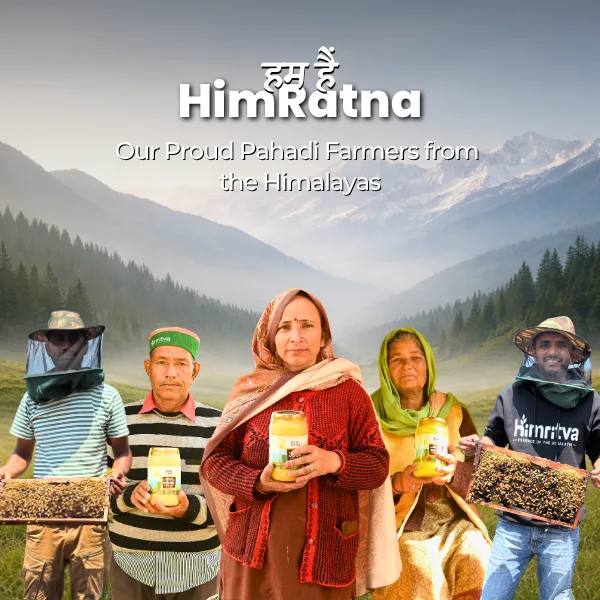
Himritva works with Pahadi farmers and Himalayan communities to source products connected to traditional mountain livelihoods. Our Himalayan Pahadi Cow Ghee is part of that larger journey.
Our farmer network, which we call our HimRatnas, forms an important link between Himalayan villages and consumers looking for authentic products from mountain communities.
The idea is simple:
Pahadi farmers → traditional food practices → carefully handled ghee → your kitchen.
This farmer-connected approach is central to Himritva’s identity. We don’t want the farmer to disappear somewhere behind a long, anonymous supply chain. We want the people behind the product to remain part of its story.
That is why every jar represents more than ghee. It represents a connection between a mountain community and a family at home.
What Makes Pahadi Cow Ghee Different?
The term “Pahadi” describes more than geography.
Mountain farming communities have traditionally developed food practices around their local environment, livestock and seasonal availability. Cattle, milk and dairy products have long been part of rural food systems across the Himalayan region.
For Himritva, the emphasis is on that connection to Pahadi farmers, Himalayan villages and traditional food practices.
Our sourcing story is built around milk from Himalayan farming communities, including cows that are traditionally raised in mountain environments and may graze on natural grasses, herbs and locally available fodder.
The result is a product whose identity is closely connected to its origin.
It is important, however, not to assume that every cow in the Himalayas eats exactly the same diet or that every batch of ghee will have identical characteristics. Natural agricultural products can vary with season, feed, milk composition and production conditions.
That variation is part of the character of traditionally sourced foods.
How Is Traditional Cow Ghee Made?
Traditional ghee-making is a multi-stage process.
While methods can differ between households, regions and producers, a traditional milk-to-ghee journey can involve several important stages.
1. Milk Collection
The process begins with fresh cow milk sourced through farming communities.
For Himritva, this stage starts with our Pahadi farmer network. The milk becomes the foundation of the finished Himalayan Pahadi Cow Ghee.
2. Milk to Curd
Traditionally, milk is cultured into curd.
This stage is particularly important in methods that use curd as an intermediate before butter is obtained.
3. Curd to Butter
The curd is churned to separate butter from the buttermilk.
Traditional churning is one of the defining features associated with the Bilona method.
4. Butter to Ghee
The butter is then heated and clarified.
As the water is driven off and the milk solids separate, the butter gradually transforms into golden ghee with its characteristic aroma and texture.
5. Filtration and Packing
The clarified ghee is filtered as appropriate and carefully packed for storage and consumption.
FSSAI’s laboratory manual specifically describes preparation and testing procedures for ghee and other milk-fat products, including melting and filtration before certain analytical examinations.
What Is the Bilona Method?
The Bilona method is a traditional Indian approach to preparing ghee in which milk is first converted into curd, the curd is churned to obtain butter, and the butter is subsequently heated to produce ghee.
The word “Bilona” is commonly associated with the traditional churning stage.
However, there is an important distinction for consumers: not every product marketed as “Bilona ghee” necessarily follows the exact same process from start to finish.
For that reason, responsible brands should describe their actual production method rather than using “Bilona” simply as a marketing keyword.
At Himritva, we prefer to communicate the process transparently and describe our ghee as following traditional ghee-making practices, with the Bilona method used where applicable to the specific production process.
That distinction matters because authenticity starts with accurate communication.
Why Does Ghee Have Such a Rich Aroma?
One of the most recognizable characteristics of traditional ghee is its aroma.
During clarification, butter undergoes physical and chemical changes that contribute to the characteristic flavour and aroma of ghee. FSSAI’s standard itself notes that ghee develops a distinctive flavour and physical structure as a result of its manufacturing process.
This is why two ghee products can look similar but smell and taste quite different.
Factors that can influence the final character include:
- Milk composition
- Feed and seasonal conditions
- Fermentation or culturing practices
- Churning method
- Heating conditions
- Clarification time
- Storage conditions
Traditional ghee is therefore not defined only by its colour.
Aroma, texture, flavour and composition all contribute to the final experience.
99.8% Milk Fat and Low Moisture: Why These Numbers Matter
When buying ghee, consumers often see claims such as “high milk fat” or “low moisture.”
These are not just marketing terms. They relate directly to the composition of ghee.
FSSAI’s cited standard sets a minimum of 99.5% milk fat and a maximum of 0.5% moisture for ghee.
Himritva’s tested sample recorded:
99.8% Milk Fat
and
0.25% Moisture
These results are especially useful as measurable quality information because they can be compared with the applicable standard.
The important point is not to claim that these numbers make one ghee automatically “healthier” than another. Instead, they provide consumers with objective information about the tested sample’s composition.
A good food brand should give customers facts they can understand rather than relying only on broad words such as “premium” or “pure.”
What Does Low Moisture Mean in Ghee?
Ghee is a concentrated milk-fat product, so very little water should remain after proper clarification.
FSSAI’s standard allows a maximum moisture level of 0.5% for ghee.
Himritva’s tested sample showed 0.25% moisture.
Lower moisture is consistent with the nature of ghee as a clarified milk-fat product, although moisture alone should never be used as the only indicator of quality.
Other analytical parameters and food-safety requirements also matter.
This is why laboratory testing is valuable: it allows a product to be evaluated using measurable characteristics rather than appearance alone.
Why Can Cow Ghee Change Colour or Texture?
Have you ever opened two jars of ghee and noticed that one looks more yellow while another appears paler?
That doesn’t necessarily mean something is wrong.
Natural ghee can vary in:
- Colour
- Aroma
- Graininess
- Texture
- Flavour
These characteristics can be influenced by milk source, animal feed, season, processing conditions and storage temperature.
Ghee can also change texture with temperature. It may become softer in warm conditions and firmer in cooler environments.
This is one reason traditionally sourced food products should not always be judged solely by visual uniformity.
A completely identical appearance from batch to batch isn’t necessarily the goal.
Consistency in quality matters more than artificial uniformity in appearance.
Is Cow Ghee Healthy?
This is where consumers should separate tradition from exaggerated health claims.
Ghee is a concentrated source of fat and energy. It can be part of a balanced diet, but it should not be treated as a miracle food or medicine.
Ghee also contains saturated fatty acids. Current evidence reviews have found that higher dietary saturated-fat intake is associated with higher LDL cholesterol and cardiovascular risk, particularly when saturated fats replace healthier unsaturated fats in the diet.
That doesn’t mean ghee needs to be eliminated from every diet. It means portion size and overall dietary pattern matter.
For someone who enjoys traditional Indian foods, a small amount of good-quality ghee can be used for flavour and cooking while keeping the overall diet balanced.
The right approach is not:
“Ghee is a superfood, so more is better.”
It is:
“Choose a good product, use it thoughtfully, and consider it as part of your overall diet.”
This is a much more responsible way to talk about traditional foods.
How to Use Himalayan Pahadi Cow Ghee
One of the reasons ghee has remained popular in Indian kitchens is its versatility.
With Roti and Paratha
A small spoonful of ghee over hot roti or paratha is a classic combination.
With Dal
Adding ghee to dal can enhance aroma and richness.
With Rice and Khichdi
A drizzle of ghee over warm rice or khichdi is one of the simplest traditional ways to enjoy it.
In Indian Cooking
Ghee can be used in a variety of Indian recipes, including sautéing, tempering and traditional sweets.
For Traditional Recipes
From halwa and laddoo to festive dishes, ghee has a long-standing role in Indian culinary traditions.
The key is not to use ghee everywhere simply because it is available.
Use it where its flavour actually adds something to the dish.
How to Choose a Good Cow Ghee
With so many products available, how should you compare them?
Here are a few things worth checking.
Look at the Ingredient Information
A straightforward ingredient declaration can help you understand what you are buying.
Check Quality Information
Look for relevant quality and laboratory information where available.
Understand the Production Method
If a brand claims a traditional or Bilona process, understand what that actually means for its production.
Look at the Source
Can the brand tell you where its milk or dairy raw material comes from?
Consider Traceability
A transparent supply chain can give you greater confidence about the journey from producer to consumer.
Don’t Buy Only on Health Claims
“Pure,” “organic,” “A2,” “Bilona,” “desi” and “traditional” can mean different things depending on the product and supporting documentation.
The best purchasing decision combines ingredients, sourcing, process, testing and transparency.
What Makes Himritva Himalayan Pahadi Cow Ghee Different?
For Himritva, the product story begins with the people.
We work with Pahadi farmers and Himalayan communities, creating market opportunities for the people behind our products.
Our Himalayan Pahadi Cow Ghee is built around several principles:
Himalayan Origin
Connected to mountain farming communities.
Pahadi Farmer Sourcing
Our HimRatnas are an important part of the journey from farm to home.
Traditional Ghee-Making
Inspired by time-tested Indian dairy practices.
Small-Batch Focus
Careful handling and attention throughout production.
Measured Quality
Our tested sample recorded 99.8% milk fat and 0.25% moisture.
Farmer-First Approach
We want the people behind the product to remain visible in its story.
For us, the objective isn’t simply to sell another jar of ghee.
It is to create a stronger connection between Himalayan producers and Indian consumers.
From Pahadi Farmers to Your Kitchen
Food often carries more history than we realise.
A spoonful of ghee can represent a farming system, a family recipe, a village tradition and a relationship with the land.
That is what makes traditional foods meaningful.
Himritva’s Himalayan Pahadi Cow Ghee is our attempt to bring that connection into modern homes without losing sight of the people who make it possible.
From milk sourced through Himalayan farming communities, through traditional preparation, to the finished jar in your kitchen—the journey matters.
And behind that journey are our HimRatnas: the Pahadi farmers and communities who help make Himalayan food traditions part of everyday life.
From Pahadi Farmers. Through Tradition. To Your Home.
That is the story behind Himritva Himalayan Pahadi Cow Ghee.
Frequently Asked Questions
Is Himalayan Pahadi Cow Ghee different from regular cow ghee?
Himalayan Pahadi Cow Ghee refers to cow ghee sourced through farming communities in the Himalayan region. Its distinctive identity comes from its geographical origin, farmer sourcing and traditional food practices.
Is Himritva Cow Ghee made using the Bilona method?
Himritva follows traditional ghee-making practices, including the Bilona method where applicable to the specific production process. The exact production method should always be understood from the product information provided.
What is the milk-fat content of Himritva Cow Ghee?
Himritva’s tested sample recorded 99.8% milk fat. FSSAI’s cited standard specifies a minimum of 99.5% milk fat for ghee.
What is the moisture content?
The tested Himritva sample recorded 0.25% moisture, compared with the cited FSSAI maximum of 0.5% for ghee.
How should cow ghee be stored?
Keep the jar tightly closed in a clean, dry place away from direct sunlight and moisture. Use a clean, dry spoon when serving and follow the storage directions on the product packaging.
Final Thoughts
The best cow ghee is not simply about a golden colour or a premium-looking jar.
It is about understanding where the milk comes from, who produces it, how it is transformed, how it is tested and how transparently that journey is communicated.
Himalayan Pahadi Cow Ghee brings an additional layer to that story: the relationship between mountain communities and the food traditions they have preserved.
At Himritva, we believe that when you bring a traditional Himalayan product into your home, you should also be able to understand the people and places behind it.
Himalayas to Home.
Himritva.